Pin it
The history of Ephesus begins with Greek settlement in the 10th century BCE and reaches its high point as a major Roman city in Asia Minor. Today, its streets, public buildings, theater, and religious sites show how a Greek port became a Roman provincial capital before its harbor slowly silted up and trade moved elsewhere.
This guide is for travelers planning a day from Kuşadası, Selçuk, İzmir, or Istanbul, as well as anyone fitting Ephesus into a longer Turkey route. You’ll find the history, the practical route through the ruins, likely costs, timing advice, and tour options without treating the site as a quick photo stop.
Quick Facts
| Best time to visit | April–May and September–October, ideally at opening time |
| Time needed | About 2–4 hours for Ephesus; allow most of a day with nearby sites |
| Getting there | Near Selçuk; about 30 minutes from Kuşadası and around 1 hour from İzmir Airport |
| Entry / typical cost | About €40 for the main archaeological site; check the current official price before travel |
| Good for | History fans, cruise visitors, families with older children, and first-time Turkey itineraries |
What is the history of Ephesus and why does it matter?
Ephesus is an ancient city near modern Selçuk on Turkey’s Aegean coast. It mattered because it sat close to a protected harbor, fertile land around the Cayster River, and trade routes linking the Aegean with inland Anatolia. That combination brought merchants, religious pilgrims, administrators, craftspeople, and eventually early Christian communities.
Greek origins and the cult of Artemis
Settlement in the Ephesus area reaches back to the 10th century BCE. Greek tradition credits Androclus, a prince of Athens, with founding the city after following an oracle’s advice. Myth is not the same as archaeology, but the story reflects Ephesus’s long Greek identity.
The city became closely associated with Artemis, the goddess linked with hunting and fertility. The Temple of Artemis stood outside the main city and was counted among the Seven Wonders of the Ancient World. Only limited remains are visible today, so visitors expecting a complete temple often feel disappointed. Its importance is historical rather than visual.

Roman prosperity and early Christianity
Ephesus expanded under Roman rule, especially after Augustus became emperor in the 1st century BCE. It served as the capital of the Roman province of Asia and developed the broad marble streets and civic buildings that visitors walk through now.
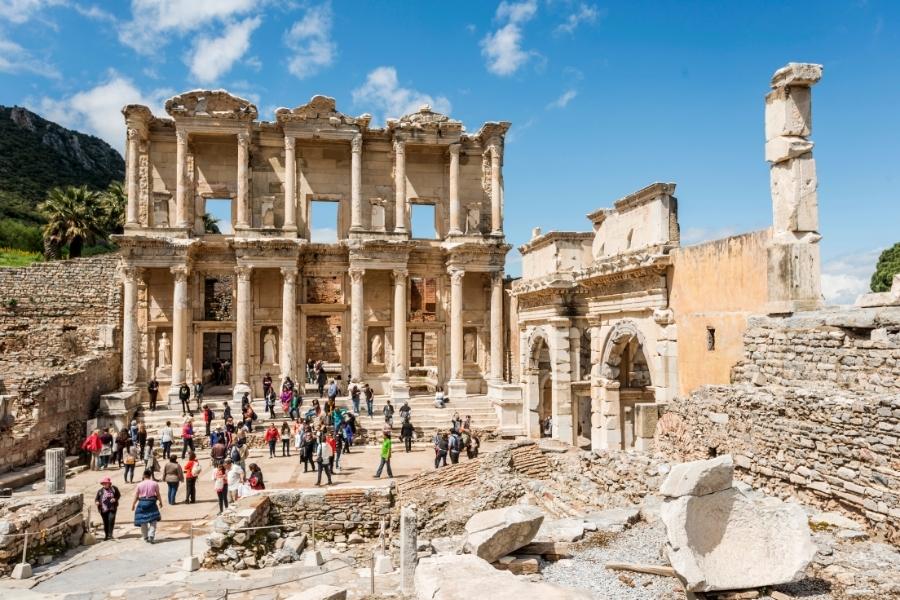
The Library of Celsus, Great Theatre, Temple of Hadrian, baths, fountains, and homes on the slopes above Curetes Street belong to this prosperous Roman period. The Terrace Houses are particularly useful for understanding daily urban life because they preserve residences used by wealthy Ephesian families.
Ephesus also appears in early Christian history. St. Paul preached here, and the city became important to Christian communities in the Roman and Byzantine periods. The scale of the Great Theatre helps explain why public preaching and public disagreement could draw large crowds in this city.
Why Ephesus declined
Ephesus did not disappear overnight. Its harbor gradually silted up, reducing the city’s usefulness as a port. Trade patterns changed, its political role weakened during the Byzantine period, and the old city was largely abandoned by the 15th century.
That decline preserved much of the street plan. You are walking through a former urban center rather than a single temple complex, which is why Ephesus works best when you understand the route instead of rushing from one façade to the next.

How do you visit Ephesus from Kuşadası, İzmir, or Istanbul?
Ephesus is closest to Selçuk, with two common entrances: the upper gate and the lower gate. Most guided visits enter at the upper gate and walk downhill toward the Great Theatre and lower gate. That route is easier on your knees than going uphill, though the marble remains uneven.
Getting to Ephesus from the main hubs
| Starting point | Typical travel time | Best choice | What to know |
|---|---|---|---|
| Selçuk | About 5 minutes by taxi | Taxi, local transport, or tour transfer | Best base if Ephesus is your main reason for staying in the area. |
| Kuşadası | About 30 minutes | Shore excursion, taxi, private transfer, or group tour | A practical option for cruise passengers and beach stays. |
| İzmir Airport | About 1 hour | Pre-booked transfer, rental car, or tour | Allow extra time for luggage, airport traffic, and the return journey. |
| Istanbul | Most of a full day by air and road transfers | Flight-based day trip or multi-day tour | Expect an early hotel pickup and a long day. |
From Istanbul, flying is the practical choice for a one-day visit. A road trip is possible, but it takes roughly 7–8 hours each way and makes little sense unless you are making stops along the Aegean route. For transfer details and independent travel options, see our guide on how to get from Istanbul to Ephesus.
Private tour, group tour, or independent visit?
Independent travel suits you if you are staying in Selçuk, have time to read the site panels, and are comfortable arranging tickets and transport. A guide is more useful than many travelers expect because Ephesus has layers from Greek, Roman, Byzantine, and modern excavation periods that are not always obvious on the ground.
A group tour is usually the better value for visitors coming from Kuşadası or Istanbul. A private tour makes more sense for families, travelers using mobility aids, cruise guests with a fixed all-aboard time, or anyone who wants to spend longer at the Terrace Houses.
If Istanbul is your base and you have one open day, the Ephesus Day Trip from Istanbul uses domestic flights and includes the logistics that make a self-arranged day complicated. It is a long day, so it suits travelers who prefer to keep their hotel in Istanbul rather than change cities.
Pro Tip
Ask where your tour enters and exits the site. Starting at the upper gate and finishing at the lower gate gives you a mostly downhill walk. If your vehicle waits at the original gate, you may need to climb back or take a transfer around the site.
What should you see at Ephesus, and in what order?
Plan a route rather than trying to cover every stone. For most visitors, the upper-to-lower walk gives the clearest story of the city: administration and elite homes above, commercial streets in the middle, then the theater and former harbor route below.
A sensible walking route through the ruins
- Upper Gate and State Agora: Begin with the civic area and views across the site. This is where your guide can explain the Roman layout before the larger crowds build.
- Odeon and public buildings: Look for the smaller theater-like Odeon and the remains of official spaces. These help distinguish local government from the larger entertainment areas farther down.
- Temple of Hadrian: Pause for the carved façade. It is one of the most photographed structures along Curetes Street, so arriving early matters.
- Terrace Houses: Pay the separate admission if Roman domestic life interests you. The covered walkways, mosaics, wall decoration, and ongoing conservation give the site a different scale from the public ruins.
- Library of Celsus: The reconstructed façade is Ephesus’s best-known view. It is usually busiest in late morning and early afternoon.
- Commercial Agora and Great Theatre: End at the theater, where you can see the size of the city’s public gathering place before continuing toward the lower gate.

The Library of Celsus is a façade reconstructed from recovered elements. It is still an important stop, but do not spend your whole visit there. The city’s paved streets, water systems, public baths, shops, and theater explain far more about how Ephesus worked.
What does Ephesus cost in 2026?
Ticket prices and opening arrangements can change, particularly at major archaeological sites. Use the amounts below as planning estimates, then check the current official price before you travel or confirm what your booked tour includes.
| Item | Typical cost | Included or extra? | Planning note |
|---|---|---|---|
| Ephesus archaeological site entry | About €40 | Extra on some tours | Check current ticket rules and whether a museum pass applies. |
| Terrace Houses | Extra charge | Usually separate from main entry | Worth adding if you want mosaics, frescoes, and Roman homes. |
| Taxi from Selçuk | Varies | Extra | Agree on the fare or use the meter before leaving. |
| Group tour from Istanbul with flights | From about €328 | Check itinerary | Usually includes transport and guiding; confirm admissions and meals. |
| Multi-day Turkey itinerary including Ephesus | From about €728 | Varies by itinerary | Useful when Ephesus is one stop among several regions. |
Before booking, check four items: site admission, Terrace Houses entry, lunch, and hotel or port transfer. “Ephesus tour” does not automatically mean every add-on is covered. It is also worth checking if the itinerary visits the House of the Virgin Mary or the Temple of Artemis, as these are outside the main archaeological ticket area.
When is the best time to visit Ephesus?
April, May, September, and October are usually the easiest months for walking outdoors. Summer brings stronger heat and limited shade across the open streets. Winter can be quieter, but rain can make polished marble slick.
| Time | What to expect | Best for |
|---|---|---|
| Opening time | Cooler temperatures and fewer large groups at the Library of Celsus | Photography, cruise visitors, and travelers sensitive to heat |
| Late morning | More organized groups and stronger sun | Visitors arriving from Kuşadası or İzmir |
| Midday in summer | Heat, glare from marble, and little shade | Only if your schedule leaves no alternative |
| Late afternoon | Light can be softer, but opening hours and transport need checking | Independent visitors staying locally |
| April–May / September–October | Milder walking conditions | Most first-time visitors |
| June–August | Hotter weather and busier paths | Travelers prepared for an early start |
Pro Tip
Wear shoes with grip rather than sandals with smooth soles. Ephesus has marble paving, steps, slopes, and irregular stones. A refillable water bottle, sun protection, and a light layer for spring or autumn make a bigger difference than carrying extra bags.
How do you plan an Ephesus visit with nearby places?
Allow 2–4 hours for the main ruins. Add time for the Terrace Houses, transfers, lunch, and nearby religious or archaeological stops. Trying to combine every location in one short shore excursion can turn the day into a sequence of parking lots and ticket lines.
Nearby stops worth adding
- House of the Virgin Mary: A religious site on Mount Koressos, commonly paired with Ephesus. Read our House of the Virgin Mary visitor guide before deciding if it belongs in your day.
- Temple of Artemis: Close to Selçuk and easy to visit briefly. Go for its place in ancient history, not for a complete structure.
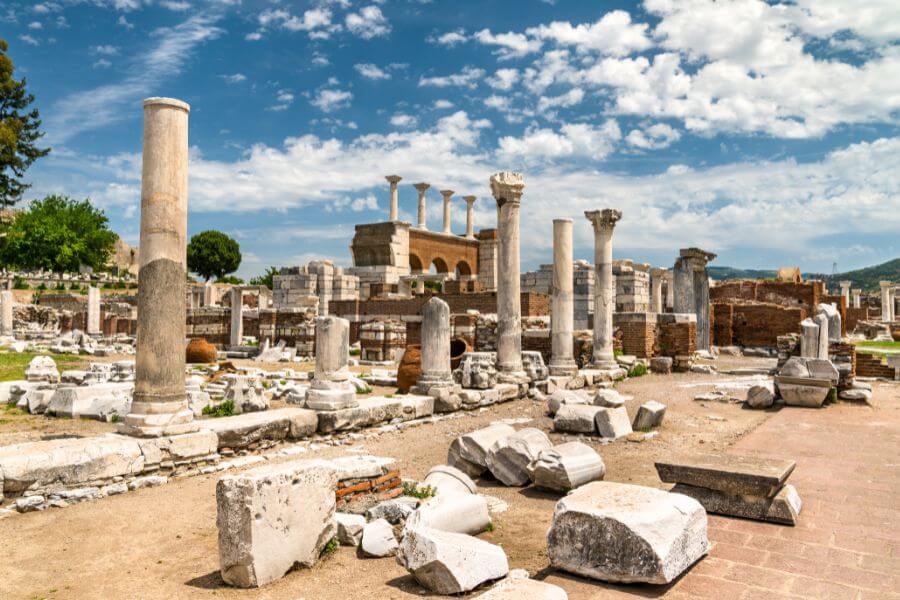
- Basilica of Saint John: In Selçuk, traditionally associated with the burial place of St. John. It fits well after Ephesus if Christian history is a priority.
- Kuşadası: A useful base for the coast and cruise arrivals. Our guide to shore excursions from Kuşadası Port can help you compare time-sensitive options.
Which longer Turkey tour works best?
For a compact route from Istanbul, the 4-Day Cappadocia, Pamukkale and Ephesus Tour from Istanbul By Plane & Bus is for travelers who want three major stops in limited time. Expect early starts and changing hotels or transport, but it avoids planning each connection yourself.
If you prefer more time between destinations, consider the 6-Day Istanbul, Pamukkale, Ephesus & Cappadocia Tour with Flights. Travelers building a broader Aegean and central Turkey itinerary can look at the 10-Day Istanbul, Gallipoli, Troy, Pergamon, Ephesus, Pamukkale & Cappadocia Tour, but confirm the exact route and current inclusions before reserving.
For a slower combination of Ephesus, Pamukkale, and Cappadocia, the 5-Day Pamukkale, Ephesus & Cappadocia Tour from Istanbul with Flights is a practical middle ground.
🎫 Recommended Ephesus Tours
Licensed guide, transport and entrance logistics handled — pick the one that matches your dates.
- 9-Day Istanbul, Cappadocia, Antalya, Pamukkale and Ephesus Tour →9 Days · from €1,670.00
- 4-Day Cappadocia, Pamukkale and Ephesus Tour from Istanbul By Plane & Bus →4 Days / 3 Nights · from €728.00
- Ephesus Day Trip from Istanbul →from €328.00
- 5-Day Pamukkale, Ephesus & Cappadocia Tour from Istanbul with Flights →5 Days / 4 Nights · from €1,035.00
Frequently Asked Questions About Ephesus
How much does it cost to enter Ephesus?
Main-site entry is about €40, but prices can change. The Terrace Houses normally require a separate ticket, and guided tours may list entrance fees as included or excluded, so check before booking.
How many hours do you need at Ephesus?
Allow 2–4 hours for the main archaeological site. Add at least another hour if you want the Terrace Houses, and allow most of a day if you are also visiting the House of the Virgin Mary, Basilica of Saint John, or the Temple of Artemis.
What is the best month to visit Ephesus?
April, May, September, and October generally offer the most comfortable conditions for a long outdoor walk. Summer visits are still possible, but an opening-time entry is much easier than arriving at midday.
Can you visit Ephesus with children?
Yes, especially with school-age children who can manage a few hours of walking. Bring water, sun protection, snacks, and shoes with grip; the site has uneven paving and little shade in several areas.
Can you do Ephesus as a day trip from Istanbul?
Yes, using a domestic flight and road transfers. It makes for an early and full day, so it works best if you have limited time and prefer not to stay overnight near Selçuk or Kuşadası.
Do you need a guide at Ephesus?
You can visit independently, but a guide helps connect the ruins to the city’s Greek, Roman, and Christian history. A guided visit is particularly useful if Ephesus is your only ancient city stop in Turkey.
Can you combine Ephesus and the House of the Virgin Mary?
Yes. They are frequently visited on the same day, with the House of the Virgin Mary usually visited before or after the ruins. Check the order, travel time, and whether entrance fees are included in your tour.
Ready to place Ephesus in a route that fits your time and travel style? Compare available Ephesus Tours or use our Turkey trip planner to build a practical itinerary.