
 Pin it
Morocco weather in August means serious inland heat and comfortable Atlantic coast days. Expect Marrakech, Fes and Meknes to sit in the high 30s Celsius (upper 90s to low 100s Fahrenheit) most afternoons, the Sahara around Merzouga hotter still, and Essaouira, Casablanca and Agadir in the 20s thanks to the ocean breeze. August travel works well if you plan around the middle of the day instead of pretending it isn’t there.
This guide is for travelers who already have August dates locked in — school holidays, company shutdowns, cheap flights — and want to know where to go, when to walk, what a trip costs and which itinerary style survives the heat. If your dates are flexible, the shoulder months are gentler; our September weather guide covers the cooldown.
Quick Facts
| Best time to visit | August suits the Atlantic coast and high mountains; inland cities and the Sahara are best handled with early starts and late finishes |
| Time needed | 5 days minimum for cities plus one desert night; 7–9 days for imperial cities and the Sahara without rushing |
| Getting there | International flights into Casablanca (CMN) or Marrakech (RAK); most multi-day tours start from one of these two cities |
| Entry / typical cost | Guided multi-day tours from €1,360 per person; monument entry tickets are usually paid separately — confirm current fees on each site’s official page |
| Good for | Beach-and-culture combinations, desert camping, families who can handle early mornings, photographers chasing long summer light |
How hot is Morocco in August, region by region?
Morocco isn’t one climate. The country runs from cold Atlantic water to the edge of the Sahara in under 600 kilometers, and August exposes that split more than any other month. Treat the numbers below as typical patterns rather than a forecast, and check the actual outlook a week before you fly.
| Region | Typical August feel | What it means for your day |
| Marrakech, Fes, Meknes | Hot, dry afternoons in the high 30s C / high 90s–low 100s F; evenings drop into the low-to-mid 20s C | Sightseeing before 11:00 and after 17:00; long lunch and a pool or riad courtyard in between |
| Essaouira, Casablanca, Rabat, Agadir | Mid-to-high 20s C / high 70s–mid 80s F with steady onshore wind | Comfortable all day; Essaouira can actually feel cool and breezy by late afternoon |
| Merzouga and Erg Chebbi (Sahara) | The hottest daytime readings in the country, dry air, sharp night cooldown | Camel trek at sunset, sunrise back to the dunes, midday indoors |
| High Atlas and Middle Atlas (Ifrane, Azrou, Dades) | Noticeably cooler with altitude; nights can need a layer | Best midday hiking and walking in the country during August |
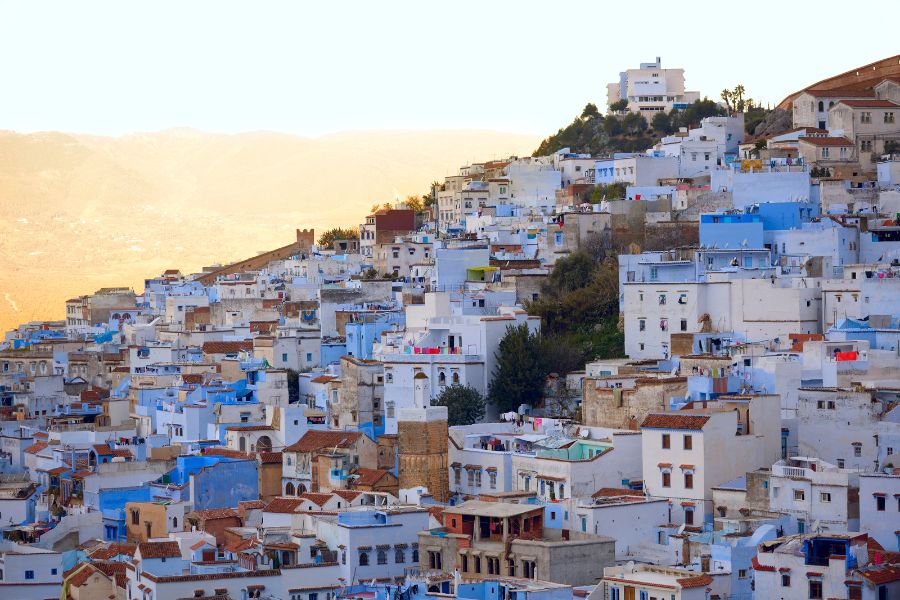
| Chefchaouen (Rif) | Warm days, cooler mountain nights | Photograph the blue lanes early, before tour groups and glare arrive |
Humidity is the quiet variable. Marrakech at 38°C in dry air is more manageable than Casablanca at 30°C with sea moisture, so don’t judge by the number alone.

Where to go in Morocco in August
The Atlantic coast is your heat insurance
Essaouira is the classic August escape: fortified ramparts, fishing port, wide beach, and wind that never really stops. Agadir is more resort-oriented with reliable swimming. Casablanca and Rabat are workable full days in August, which is why so many itineraries handle Hassan II Mosque and the Kasbah of the Udayas at the start of a trip, before heading inland.
The Sahara still works — with the right schedule
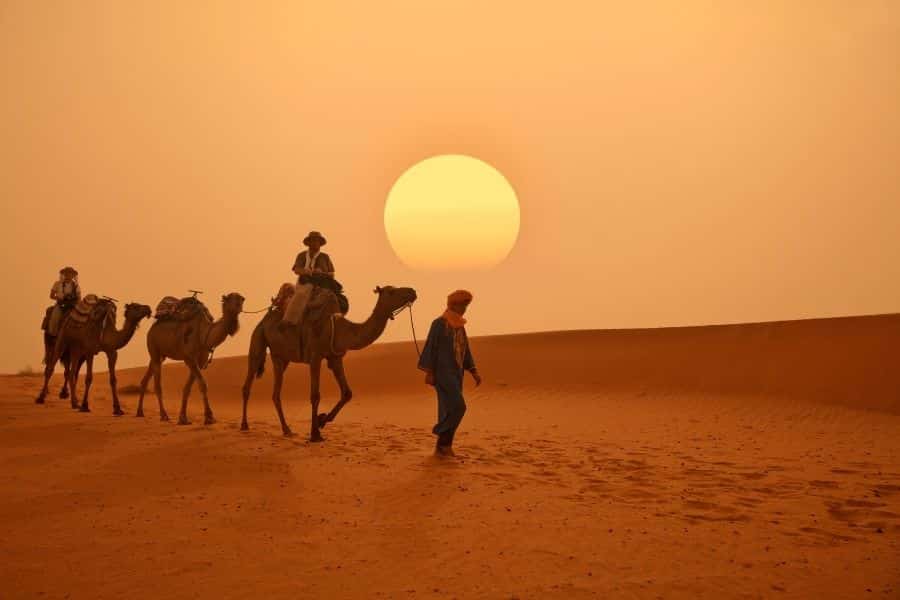
Desert nights in August are the payoff: dry air, clear sky, temperatures that fall away after dark. The camel trek into Erg Chebbi is scheduled around sunset for exactly this reason, and camps wake you for sunrise before the heat returns. What you should not do is plan long midday walking in the dunes.
The mountains are underrated in summer
Routes over the Tizi n’Tichka pass climb to roughly 2,260 meters, and the Dades and Todra gorges hold shade and running water. Ifrane and the Azrou cedar forest, with their Barbary apes, feel like a different country in August. Any itinerary that puts a mountain night between two hot-city nights is doing you a favor.
Cities: shorten, don’t skip
Fes el-Bali and the Marrakech medina are still worth every minute; you just take them in two shorter sessions instead of one eight-hour march. Covered souks hold heat but block sun, and mint tea stops are a legitimate cooling strategy.
Pro Tip
Book accommodation with a courtyard pool or a genuinely cool ground-floor room in Marrakech and Fes. In August, where you rest between 13:00 and 17:00 shapes your trip more than which monument you see. Traditional riads are built around shaded courtyards for this reason.
Best time of day to sightsee in August
- 06:30–08:00. Sunrise over the dunes, empty blue lanes in Chefchaouen, cool rooftop breakfasts. The best photography hour of the day.
- 08:30–11:30. Guided medina walks, Volubilis, tanneries, palaces. Most tour days start around 08:00–08:30 for exactly this window.
- 11:30–16:30. Long lunch, museum interiors, hammam, pool, driving in an air-conditioned vehicle. Road transfers are a fine use of peak heat.
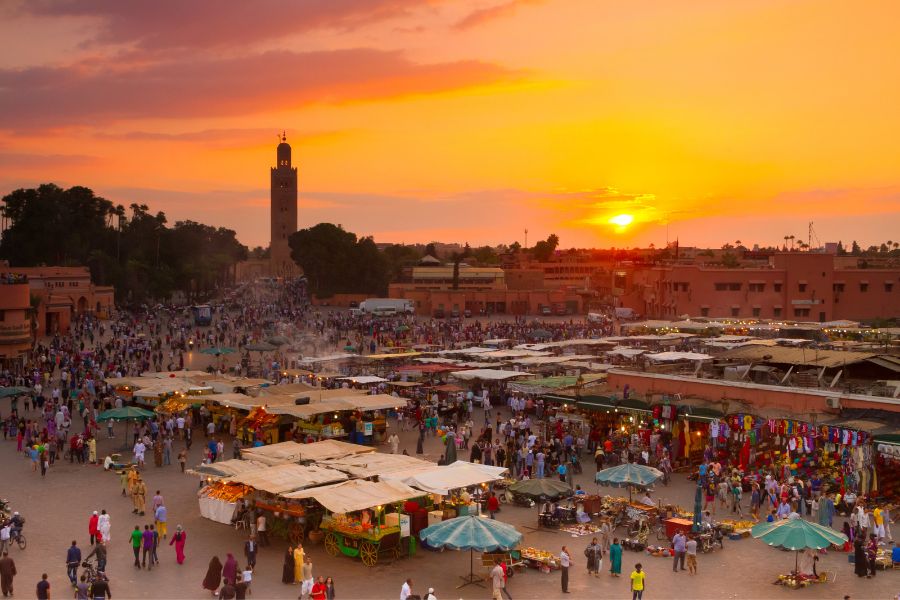
- 17:00–19:30. Souks reopen properly, Jemaa el-Fnaa fills up, camel treks set off, the light turns gold.
- After 20:30. Dinner. Moroccans eat late in summer and the streets stay busy well past midnight.
One crowd note: August brings both European holidaymakers and Moroccans living abroad returning home. Coastal towns and Marrakech restaurants get busy in the evening, while midday sites are often the emptiest they will be all year.
What a Morocco trip costs in August
Below are starting prices from our current Morocco programs. They vary by travel date, party size and room configuration, and larger groups usually bring the per-person figure down.
| Tour | Length | From (per person) |
| 5 Days Casablanca to Marrakesh via Sahara and Fes | 5 days | €1,360 |
| 6-Day Morocco Desert Tour from Marrakech | 6 days | €1,570 |
| 7-Day Morocco Desert Tour from Casablanca to Marrakech | 7 days | €1,570 |
| 7-Day Morocco Imperial Cities Tour | 7 days | €1,680 |
| 8-Day Morocco Adventure Desert Tour | 8 days | €1,970 |
| 9-Day Casablanca to Marrakech via Chefchaouen and Merzouga | 9 days | €2,130 |
Budget separately for international flights, your Morocco visa if your nationality needs one, lunches and drinks, tips, travel insurance, and monument entry tickets, which most of these programs exclude. Admission prices are set in Moroccan dirham and change; check the official page for each site rather than relying on figures in travel articles. The exception worth reading closely is the imperial cities program, where the listed inclusions cover the entrance fees indicated in that itinerary — verify the details on the tour page before booking.
Getting there and how long the driving takes
Most travelers fly into Casablanca (CMN) or Marrakech (RAK). Direct flights run from major European hubs; from the US, you’ll usually connect in Europe or fly the nonstop into Casablanca. Airport pickups are standard on our multi-day programs.
Distances are the thing people underestimate. On the 6-day desert loop, Marrakech to the Dades Valley via Ait Ben Haddou and Ouarzazate is roughly 315 km, and Dades to Merzouga about 255 km. On the 5-day route, the Fes to Merzouga day is around eight hours of travel including stops. In August, that’s a feature: you’re in an air-conditioned vehicle while it’s 40°C outside, and you arrive in time for the sunset camel ride.
Pro Tip
If August is your only option and heat worries you, run the trip in the direction that ends on the coast or in the mountains. Finishing hot and dusty in Marrakech is harder than finishing with an Essaouira day or a night in the Dades Valley where the temperature actually drops.
What to pack for Morocco in August
- Loose cotton or linen, long sleeves and long trousers — covered skin beats bare skin in direct sun, and it’s more comfortable in conservative neighborhoods
- Wide-brimmed hat, sunglasses, high-SPF sunscreen, lip balm
- A refillable bottle plus electrolyte tablets; dry heat dehydrates you before you feel thirsty
- Broken-in walking shoes for medina cobbles and gorge paths, plus sandals
- One warm layer and a light scarf for desert nights, mountain evenings and Essaouira wind
- Swimwear — riad pools, Atlantic beaches and hotel pools all come into play
- Head covering and modest clothing for mosque exteriors and religious sites
Which Morocco tour fits which traveler in August?
Private travel is the standard on our Morocco programs, which matters in summer: you set the departure hour, you take the extra shade stop, and nobody argues about the air conditioning.
If you have a short window and want cities plus one desert night, the 5 Days Morocco Tour from Casablanca to Marrakesh via Sahara desert and Fes is the compact option — private, air-conditioned transport with an English-speaking driver, riad and desert-camp nights, four breakfasts and four dinners, and the camel ride included. Lunches, monument tickets and an escorting guide are not included, and it needs booking at least 10 days ahead.
Travelers who care more about monuments than dunes should look at the 7-Day Morocco Imperial Cities Tour: Rabat, Meknes, Volubilis, Fes and Marrakech with guided historical days and 4-star hotels or riads. It’s city-heavy, so August afternoons will be spent indoors or resting — which suits travelers who don’t want long desert drives.
For a longer loop with more variety in altitude and scenery, the 9-Day Morocco Tour: Casablanca to Marrakech via Chefchaouen and Merzouga Desert adds the blue city in the Rif mountains and a full Fes day with a local guide, which spreads the hot days out. Check meal inclusions and hotel categories on each tour page before you book, since they differ between programs.
Common August mistakes
- Scheduling a medina walking tour at 13:00. It’s the one hour you should be sitting down.
- Packing only shorts and tank tops. You’ll burn, and you’ll feel out of place in older neighborhoods.
- Assuming the Sahara is unbearable. Nights are the good part; the schedule just shifts.
- Skipping the coast entirely. Two days in Essaouira or Agadir resets an inland-heavy trip.
- Leaving booking late. August is peak season for domestic and returning-diaspora travel, so riads and camps fill.
If August still feels like too much, compare it against the shoulder — our October guide covers the month most travelers rate the sweet spot.
🎫 Recommended Morocco Tours
Compare the itinerary, inclusions and optional extras. Starting prices vary by date and party size.
- 5 Days Morocco Tour from Casablanca to Marrakesh via Sahara desert and Fes →5 Days · from €1,360.00
- 6-Day Morocco Desert Tour from Marrakech →6 Days · from €1,570.00
- 8-Day Magical Morocco Tour →8 Days · from €1,715.00
- 9-Day Morocco Tour: Casablanca to Marrakech via Chefchaouen and Merzouga Desert →9 Days · from €2,130.00
Frequently Asked Questions About Morocco
Is August a good time to visit Morocco?
Yes, if you plan around the heat. The Atlantic coast and the Atlas Mountains are pleasant, the Sahara is spectacular at sunset and sunrise, and inland cities are perfectly doable in the morning and evening. It’s a poor month for all-day, on-foot city marathons.
How hot does the Sahara get in August?
Merzouga and Erg Chebbi record the hottest daytime temperatures in the country, well above what inland cities see, but the air is very dry and nights cool sharply. Tour itineraries handle this by scheduling the camel trek at sunset and waking you for sunrise. Check a current forecast close to your date.
What should I wear in Morocco in August?
Lightweight, loose, long-cut clothing in cotton or linen, plus a hat and sunglasses. Cover shoulders and knees in medinas and near religious sites. Bring one warm layer for desert and mountain nights, and shoes you can walk uneven medina streets in.
How much does a Morocco tour cost in August?
Our multi-day private programs start from €1,360 per person for five days and from €2,130 for nine days, with the exact figure depending on date and party size. Flights, visa if required, lunches, tips, insurance and monument entry tickets are generally extra — confirm inclusions on the individual tour page.
Is Morocco in August suitable for families with kids?
It can be, with a coastal or pool-based base and early starts. Families usually do better with fewer stops and longer stays than with a fast multi-city loop. Note that our Morocco desert programs are listed as not wheelchair accessible, which is worth checking if you travel with a stroller or limited mobility.
Can I combine Morocco with Turkey on one trip?
Yes. Our 15-Day Tour of Turkey and Morocco pairs Istanbul, Cappadocia and the Aegean with Morocco in a single 15-day program, from €4,160 per person. In August, expect heat in both countries, so the early-morning-and-evening rhythm applies on either side of the trip.
How many days do I need in Morocco?
Five days covers Casablanca, Fes and one desert night at a brisk pace. Seven days lets you add either the imperial cities or a proper Marrakech day. Nine days is the comfortable version, with Chefchaouen and slower mountain sections built in — which matters more in August than in spring.
Pick your dates, then pick the route that keeps you out of the midday sun: coast and mountains for the hot hours, cities and dunes for the cool ones. Browse the full range of itineraries on our Morocco Tours page and check the day-by-day inclusions before you book.
