
 Pin it
Pamukkale weather by month is coolest and quietest from January to February, hottest in July and August, and most comfortable for walking in March to May and September to October. For most travelers, April, May, September, and October offer the best balance of manageable temperatures, daylight, and time outside at the Pamukkale travertines and Hierapolis.
This guide is for travelers planning a day trip or overnight stay from Istanbul, Izmir, Cappadocia, or the Turkish coast. It explains what changes through the year, how to plan your route, what you’ll pay, and when a guided tour makes more sense than doing the trip on your own.
Quick Facts
| Best time to visit | April to May and September to October for milder walking weather |
| Time needed | At least half a day; a full day for the travertines, Hierapolis, and Cleopatra Antique Pools |
| Getting there | About 30 minutes by road from Denizli; domestic flights and long-distance buses connect major cities |
| Entry / typical cost | Hierapolis-Pamukkale entry is about €30; Cleopatra Antique Pool admission is extra |
| Good for | History fans, thermal-bath visitors, families with older children, and Turkey multi-stop itineraries |
What is Pamukkale and why does the weather matter?
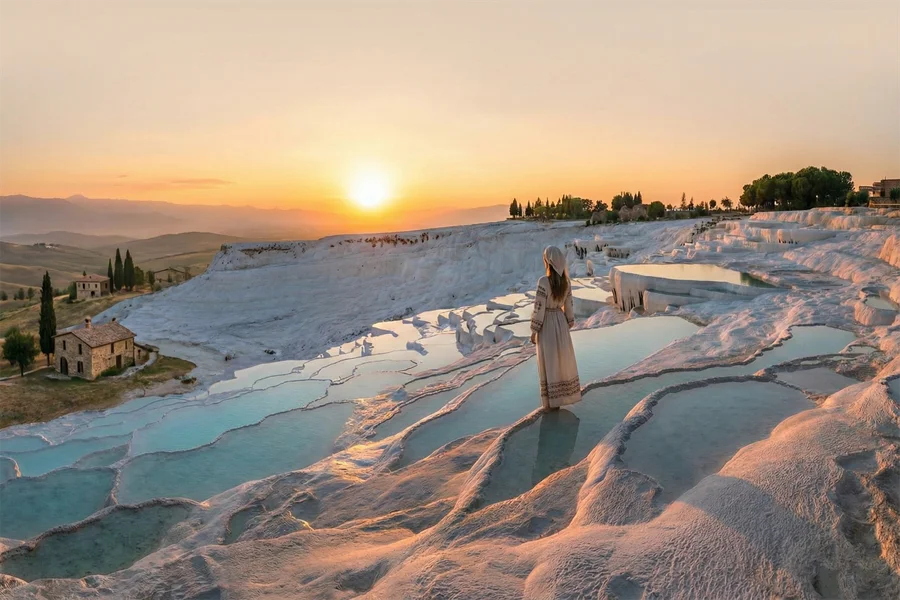
Pamukkale means “cotton castle” in Turkish. Its white slopes are travertine, formed as mineral-heavy thermal water flows over the hillside and leaves calcium deposits behind. You can walk barefoot on designated parts of the terraces, where shallow water may be present depending on the flow and conservation measures that day.
The site is also tied to ancient Hierapolis, a Greco-Roman spa city above the terraces. A visit usually includes both places: the white travertines below, then the Roman streets, baths, necropolis, theater, and thermal pool area higher up.
Weather makes a real difference because there is little shade across the open ruins and white stone reflects heat strongly. Summer visits call for an early start. Winter visitors need layers, especially after the sun drops, but may find the site less crowded.

How to get to Pamukkale from Istanbul, Izmir, and Cappadocia
Pamukkale is beside the town of Denizli in southwestern Turkey. Denizli Çardak Airport is the closest airport, while Denizli’s bus station is the main arrival point for overland travelers. From either place, you continue by road to Pamukkale village.
From Istanbul
Flying to Denizli is the practical choice if you have limited time. The flight itself is about one hour, followed by a road transfer of roughly 30 minutes from Denizli toward Pamukkale. A bus from Istanbul takes much longer and usually means an overnight or full-day journey.
If you want Pamukkale as part of a short Turkey route without managing connections, the 4-Day Pamukkale, Ephesus and Cappadocia Tour from Istanbul by Plane combines domestic flights with three major stops.
From Izmir and Ephesus
From Izmir, allow roughly three to four hours by road, depending on traffic and stops. Many travelers visit Ephesus first, stay around Selçuk or Kuşadası, then continue inland to Pamukkale. Read our practical guide to getting from Izmir to Pamukkale before booking a bus or private transfer.
From Cappadocia
Cappadocia to Pamukkale is a long overland route, so it works best as part of a multi-day itinerary rather than a day trip. Buses are available, while tours often combine a domestic flight on one leg with road travel between destinations. Our Cappadocia to Pamukkale transport guide explains the route options in more detail.
Pro Tip
Do not book a same-day return flight from Denizli unless your schedule leaves plenty of room for road transfers and airport check-in. Pamukkale needs more than a quick stop, and the ruins are a long walk from the terrace entrance.
What to see in Pamukkale in the best order
A sensible visit starts before the middle of the day, especially from June through August. Begin with the terraces while the stone is cooler, continue uphill through Hierapolis, then decide whether you want time for the Antique Pool or a longer walk to the theater.
- Walk the Pamukkale Travertines. Enter the marked barefoot section and take your time. Surfaces can be wet and slippery, and some pools may be dry or closed for protection. Our Pamukkale Travertines visitor guide covers the walking rules and what to expect.
- Explore Hierapolis. Follow the paths into the ancient city. The theater is worth the uphill effort if you are comfortable with stairs and uneven ground.
- Choose Cleopatra Antique Pools if swimming matters to you. This separate thermal pool has submerged ancient columns and requires an additional ticket. It is a pool experience, not part of the terrace walk. See our Cleopatra Antique Pools visitor guide for practical details.
- Allow time for the Roman Baths and museum area. This is the better choice for travelers who want archaeology rather than another swim.

The full site can easily fill a day. If you only have a few hours, prioritize the terraces, the main Hierapolis paths, and the theater if mobility allows. For more ideas beyond the central route, use our Pamukkale things to do guide.
What does Pamukkale cost in 2026?
Prices can change during the year, so treat these as planning figures and confirm the current rate before you travel. The main admission covers the archaeological area and travertines together. Swimming at Cleopatra Antique Pools, food, lockers, transport, and optional activities are separate expenses.
| Item | Typical 2026 cost | What to know |
|---|---|---|
| Hierapolis-Pamukkale entry | About €30 | Includes the travertines and archaeological site; check the current ticket price. |
| Cleopatra Antique Pool | Extra charge | Separate admission from the main site ticket. |
| Local transfer from Denizli | Varies | Public transport costs less than a taxi or private transfer. |
| Food and drinks | Varies | Bring water; prices at major visitor sites are usually higher. |
| 4-day guided itinerary | From €728 | Includes Pamukkale, Cappadocia, and Ephesus on the listed itinerary. |
| 5-day guided itinerary with flights | From €1,035 | Combines Pamukkale, Ephesus, and Cappadocia. |
For a fuller look at transport, lodging, meals, and paid activities, see how much a Pamukkale trip costs in 2026.
Pamukkale weather by month: when should you go?
The best month depends on whether you care most about mild walking conditions, lower visitor numbers, or summer light. Temperatures below are useful seasonal ranges, but weather can change quickly. Check the forecast a few days before arrival.
| Months | Typical conditions | Best for | Watch out for |
|---|---|---|---|
| January and February | About 5°C to 10°C | Quieter paths and thermal bathing | Cold evenings, rain, and slippery surfaces |
| March and April | About 12°C to 20°C | Terraces, ruins, and longer walks | Bring a layer for cooler mornings |
| May and June | About 20°C to 30°C | Long daylight and warm weather | Sun exposure increases quickly by June |
| July and August | Often up to 35°C | Early visits and late-afternoon light | Heat, crowds, and little shade |
| September and October | About 20°C to 28°C | Comfortable touring with fewer crowds | October evenings can feel cool |
| November and December | About 8°C to 15°C | Lower-season travel and thermal pools | Shorter days and wetter conditions |
Best time of day for the terraces
Arrive near opening time if you are visiting in summer. You will avoid the strongest heat and have more room on the barefoot terrace route. Late afternoon can also work, particularly in spring and autumn, but do not leave the theater and ruins until the final hour if you want to see them properly.
Practical Pamukkale tips for tickets, swimming, and walking
Most first-time visitors underestimate the walking. The site combines smooth but wet travertine, exposed paths, stone steps, and uneven archaeological ground. Good planning matters more than bringing a long list of gear.
- Wear shoes that are easy to remove. You must go barefoot on the designated travertine route.
- Pack sunscreen, a hat, and water from May through October.
- Bring a swimsuit and towel only if you plan to pay for Cleopatra Antique Pools.
- Take a warm layer from November through March, plus a rain layer if rain is forecast.
- Use footwear with grip for the ruins after finishing the barefoot section.
- Carry small cash or a payment card for extras, but check accepted payment methods on arrival.

Is Pamukkale suitable for families and visitors with limited mobility?
Families with children who can manage walking generally do well, but supervise them closely on wet stone. Strollers are difficult on terrace paths and archaeological surfaces. Visitors with limited mobility should focus on accessible viewing areas and discuss the day’s route with their guide or driver before buying a full itinerary that includes the theater.
Pro Tip
Do not expect every white terrace to hold bright blue water. Water flow is managed to protect the travertine, so conditions vary. The landscape and Hierapolis remain worth visiting even when some basins are dry.
How to combine Pamukkale with Hierapolis, Ephesus, and Cappadocia
Pamukkale works best with an overnight stay nearby or as one stop on a route across western and central Turkey. Trying to connect Istanbul, Pamukkale, Ephesus, and Cappadocia independently in only a few days can mean too much airport time and too little time at each site.
For a compact route, the 4-Day Cappadocia, Pamukkale and Ephesus Tour from Istanbul By Plane & Bus starts from €728 and suits travelers comfortable with a faster-paced schedule. If you prefer domestic flights and an extra day, consider the 5-Day Pamukkale, Ephesus & Cappadocia Tour from Istanbul with Flights, from €1,035.

With more time, add Antalya after Pamukkale or build a broader route through Istanbul, Cappadocia, Ephesus, and the coast. The 7-Day Cappadocia, Pamukkale & Antalya Tour from Istanbul is a better fit if you want Pamukkale alongside a Mediterranean stop rather than rushing back to Istanbul.
Should you take a Pamukkale tour or travel independently?
Independent travel is a good option if you are staying in Denizli or have time to work around bus connections. It gives you freedom to arrive early, choose your swim time, and stay overnight. The trade-off is arranging airport or bus-station transfers and managing luggage between destinations.
A group tour makes sense for travelers starting in Istanbul who want Pamukkale, Ephesus, and Cappadocia in one booking. Check the itinerary carefully for included domestic flights, accommodation, entry tickets, meals, airport transfers, and whether Cleopatra Antique Pool or optional activities cost extra.
Private arrangements suit families, travelers with reduced mobility, and anyone who wants more control over pace. For a longer first visit to Turkey, the 8-Day Istanbul, Cappadocia, Ephesus, Pamukkale & Antalya Tour starts from €1,580 and spreads the key stops across more days.
🎫 Recommended Pamukkale Tours
Licensed guide, transport and entrance logistics handled — pick the one that matches your dates.
- 4-Day Pamukkale, Ephesus and Cappadocia Tour from Istanbul by Plane →4 Days / 3 Nights · from €905.00
- 7-Day Cappadocia, Pamukkale & Antalya Tour from Istanbul →7 Days / 6 Nights · from €1,195.00
- 6-Day Istanbul, Pamukkale, Ephesus & Cappadocia Tour with Flights →6 Days · from €1,418.00
- 8-Day Istanbul, Cappadocia, Ephesus, Pamukkale & Antalya Tour →8 Days · from €1,580.00
Frequently Asked Questions About Pamukkale
How much does it cost to enter Pamukkale?
Entry to the combined Hierapolis-Pamukkale site is about €30, though official prices can change. Cleopatra Antique Pool swimming costs extra, as do transport, food, and any optional activities.
How long do you need at Pamukkale?
Allow at least half a day for the travertines and the main areas of Hierapolis. A full day is better if you want to swim at Cleopatra Antique Pool, see the theater, and walk the archaeological site without rushing.
What is the best month to visit Pamukkale?
April, May, September, and October are usually the best months for walking because temperatures are milder than high summer. July and August are workable if you arrive early, while winter suits travelers who prefer lower visitor numbers.
Can children visit Pamukkale?
Yes, Pamukkale can work well with children who are comfortable walking. The travertines are wet and slippery in places, so close supervision is important, and strollers are not practical on many parts of the site.
Can you visit Pamukkale from Istanbul in one day?
It is possible with flights and early planning, but it is a long day with airport transfers on both ends. An overnight stay or a multi-day itinerary gives you more useful time at the travertines and Hierapolis.
Do you need separate tickets for Cleopatra Antique Pool?
Yes. The Antique Pool is inside the wider site area but swimming requires separate admission. Bring swimwear if you plan to use it, and check current prices and pool conditions when you arrive.
Can Pamukkale be combined with Ephesus and Cappadocia?
Yes, it is one of the most common multi-day Turkey routes. Plan at least four or five days for these three destinations, and use domestic flights or a tour if you want to reduce transport planning.
Compare the available Pamukkale Tours when you are ready to choose a route, or use our Turkey trip planner to map Pamukkale into a wider Turkey itinerary.